Posts

Showing posts with the label Info Sihat

Proses Penurunan Berat Badan Secara Sihat

— Jika anda mengurangkan pengambilan kalori sebanyak 500 kkal sehari , anda boleh menurunkan berat badan sebanyak 0.5 kg seminggu. Dalam sebulan, anda akan kehilangan berat badan sebanyak 2 kg hingga 4 kg . Pengurangan berat badan yang  disarankan adalah sebanyak 10% daripada berat badan asal dalam masa 6 bulan.  Sekiranya penurunan berat badan melebihi 10% dalam masa 6 bulan, anda akan; — Berisiko tinggi mendapat batu hempedu. Elektrolit tidak normal. — Kekurangan nutrien. — Peningkatan asid urik. — Kehilangan protein dan otot. Selepas 6 bulan, penurunan berat badan akan statik dan anda tidak akan mengalami penurunan berat badan lagi. — Ini adalah kerana, apabila berat badan anda menurun, tahap metabolisme juga menurun kerana kehilangan otot-otot. Oleh yang demikian, adalah penting untuk menggabungkan DIET dan SENAMAN dalam proses penurunan berat badan.          Pengurusan Pemakanan Untuk Berat Badan Berlebihan     ...
What are the major functions of water in the body?

Water is essential if the other nutrients are to function properly within the human body; it is the solvent for life. It has a number of diverse functions that may be summarized as follow: 1. Water provides the essential building material for cell protoplasm, the fundamental component of all living matter. 2. Because water cannot be compressed, it serves to protect key body tissues such as spinal cord and brain. 3.Water is essential in the control of the osmotic pressure in the body, or the maintenance of a proper balance between water and the electrolytes. Any major changes in the electrolyte concentration may adversely affect cellular function. A serious departure from normal osmotic pressure cannot be tolerated by the body for long. 4. Water is the main constituent of blood, the major transportation mechanism in the body for conveying oxygen, nutrients, hormones and other compounds to the cells for their use and for carrying waste products of metabolism away from the cells to organs...

What is Energy?

For our purposes, energy represents the capacity to do work. Work is one form of energy, often called mechanical or kinetic energy. When we throw a ball or run a mile, we have done work; we have produced mechanical energy. Energy exists in variety of other form in nature, such as the light energy of the sun, nuclear energy in uranium, electrical energy in lightning storms, heat energy in fires and chemical energy in oil. The six form of energy is; mechanical, chemical, heat, electrical, light and nuclear are interchangable acconding to various laws of thermodynamics. We take advantage of these laws every day. One such example is the use of the chemical energy in gasoline to produce mechanical energy, the movement of our cars. In the human body, four of these types of energy are important. Our bodies possess stores of chemical energy that can be used to produce electrical energy for creation of electrical nerve impulses to produce heat energy to help keep our boy temparature at 37 d...

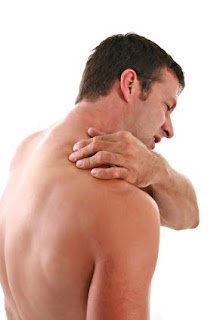
Avoid Shoulder Pain

Image
~Shoulder exercises to help you avoid shoulder pain~ 1. Balance your upper body workouts A good way to avoid shoulder injuries is to make sure your upper body strength sessions are balanced. This means that every push or press exercise must be balanced with a pull or row exercise. Too many athletes and weight trainers focus on developing the 'mirror muscles', the upper trapezius, anterior deltoid and pectorals. As a consequence, the 'non-mirror muscles', lower trapezius, rhomboids, latissimus dorsi and rear deltoid, are underdeveloped. This leads to a muscular imbalance about the shoulder, which results in poor scapular stabilisation. since the non-mirror muscles are the ones that work to stabilise the scapula. In addition, over-developed mirror muscles can lead to a round-shouldered posture, which incorrectly places the scapula up and forward. Redressing this imbalance is very important for the prevention and rehabilitation of shoulder impingement injuries The followi...

Your Bones!!! What is functions?

Image
The skeletal system is a complex and multi-functional system. Its main functions are: a. Support -Bone is the major supporting tissue of the body. It is a strong tissue that can support huge quantities of weight, and can be considered the load bearing foundation of our bodies. In addition to bone, cartilages provides a firm but flexible support in some structures such as our trachea, while ligaments attach to bones and help to join bones together and hold them firmly. b. Movement -Our movement is achieved through the cooperative function of our muscles and our bones. Muscles are attached to bones by tendons, and through the presence of joints, allow for the movement of our limbs. c. Protection -Bone is hard and firm, and is vital as a protective tissue for our most important organs. The skull surrounding and protecting the brain is the best example of bone performing such a function. Another example is the rib cage which surrounds and protects the heart and the lungs, as well as the ...

Your Heart!!!

Do you agree that the heart is just like a pump? Well, it is true. The heart functions as a muscular pump in our body. In this topic, you are going to learn all about the heart along with its cardiac cycle, circulation, electrical activity and pressure mechanism. Note that deoxygenated blood from the main veins flows into the vena cava. The blood from the vena cava goes into the right atrium, pumped into the right ventricle through the tricuspid valve and out of the right side of the heart through the pulmonary artery. The blood then flows into the lungs where there is diffusion of gas whereby CO2 is released into the alveolus and O2 diffuses into the arterial side of the circulation. Blood rich in oxygen then goes into the pulmonary vein on its way into the left atrium. From the left atrium the blood flows into the left ventricle through the bicuspid (mitral) valve. The strong pumping action of the left ventricle forces oxygenated blood into the aorta and then through the arteries to ...